
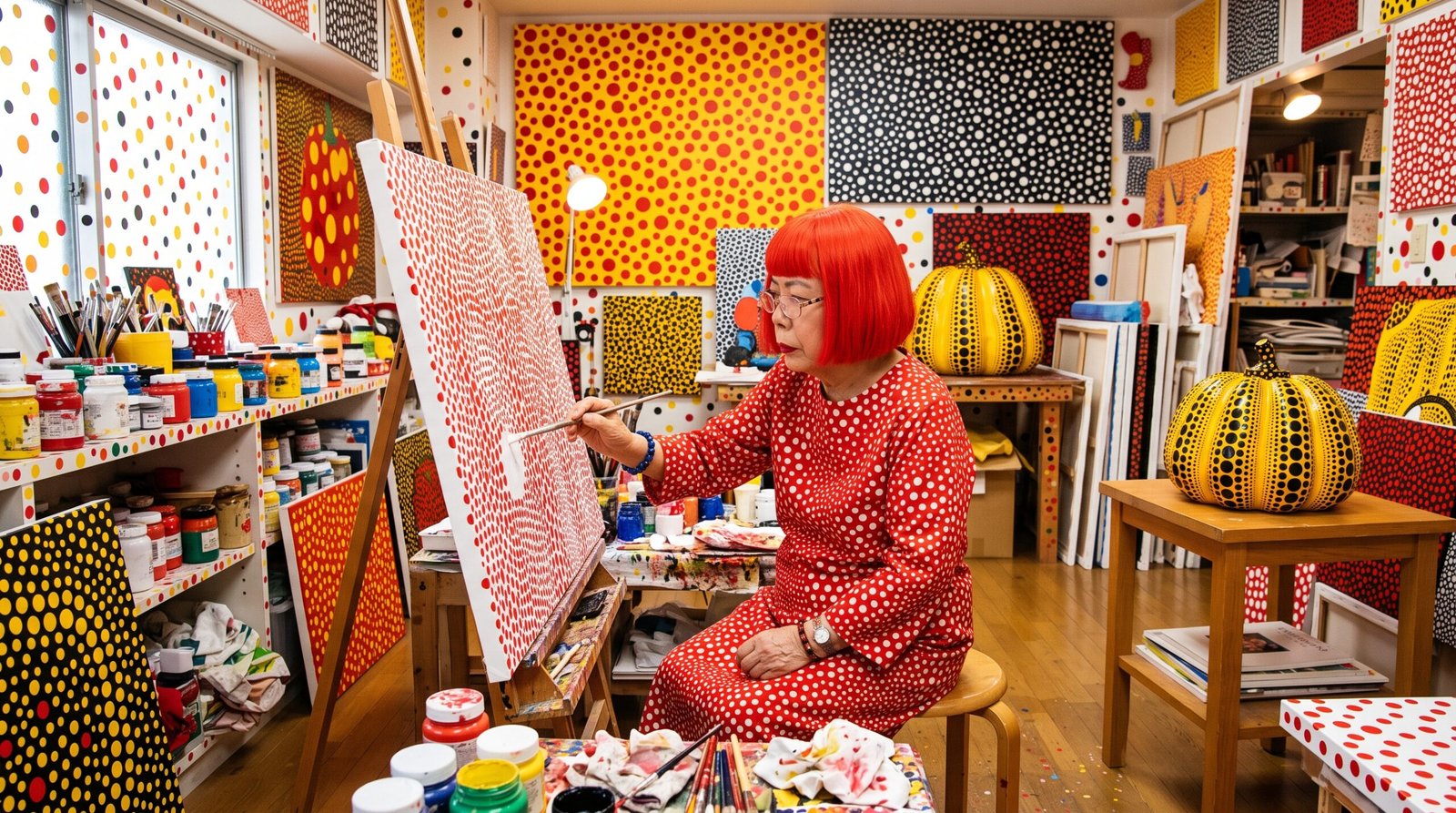
The art world fell silent this week as news broke of the passing of one of the most singular creative minds of the 20th and 21st centuries.
Yayoi Kusama, born March 22, 1929, in Matsumoto, Japan, died on August 14, 2026, in Tokyo. She was 97 years old. One of the world’s most celebrated and best-selling artists, her death was confirmed through a statement on the artist’s official website.
Her name became synonymous with boundless creativity, psychedelic dots, and mirror-lined rooms that made visitors feel they were floating inside infinity itself. She was, by every measure, unlike anyone who had ever picked up a brush.
Who Was Yayoi Kusama?
Early Life in Japan
Yayoi Kusama was born on March 22, 1929, in the rural town of Matsumoto, Japan, to parents who ran a plant nursery. She said she had a deeply unhappy childhood, at the mercy of a physically abusive mother and a philandering father.
Art became her escape — and later, her salvation.
By her own account, Kusama began painting as a child, around the time she began experiencing hallucinations that often involved fields of dots. Those hallucinations and the theme of dots would continue to inform her art throughout her entire career. She had little formal training, studying art only briefly — from 1948 to 1949 — at the Kyōto City Specialist School of Arts. Yet what she lacked in formal education, she more than compensated for in raw, relentless vision.
Mental Health and Art as Survival
Kusama’s relationship with her mind was one of the most publicly documented in modern art history. Diminutive and known for sporting a scarlet bob wig later in life, Kusama was candid about her mental health struggles, saying she experienced visions and hallucinations of flashing lights, dots, and flowers since childhood.
Rather than suppress these experiences, she channeled them directly into her work — painting them, sculpting them, installing them — until the outside world could see what she saw from the inside.
The mental health crises she had experienced since childhood never went away and, after 1977, she voluntarily lived in a Tokyo psychiatric hospital. Even so, she never stopped working. According to a statement by the Yayoi Kusama Museum, she continued to paint until her very final days.
Yayoi Kusama’s Death — What We Know
When Did Yayoi Kusama Die?
Kusama died in a Tokyo hospital on August 14, 2026, according to a statement on her official website. The announcement was made publicly on August 26, 2026 — nearly two weeks after her passing. The official statement read: It is with profound sorrow that we announce the passing of Yayoi Kusama at a hospital in Tokyo on August 14.
Cause of Death
The cause of death was multiple organ failure, according to Kyodo News. The Yayoi Kusama Studio’s official statement did not specify a cause.
Official Statement from Yayoi Kusama Studio
The studio’s statement was a fitting tribute to an artist who never separated her being from her work. She continued to paint until her final days, never setting aside her brush, and continued exploration of forever love and eternal soul,” the studio’s statement said.
We will carry forward Kusama’s wishes and, through art, continue to bring hope and strength for the future to people around the world,” the studio added.
Yayoi Kusama’s Most Iconic Works
Infinity Mirror Rooms
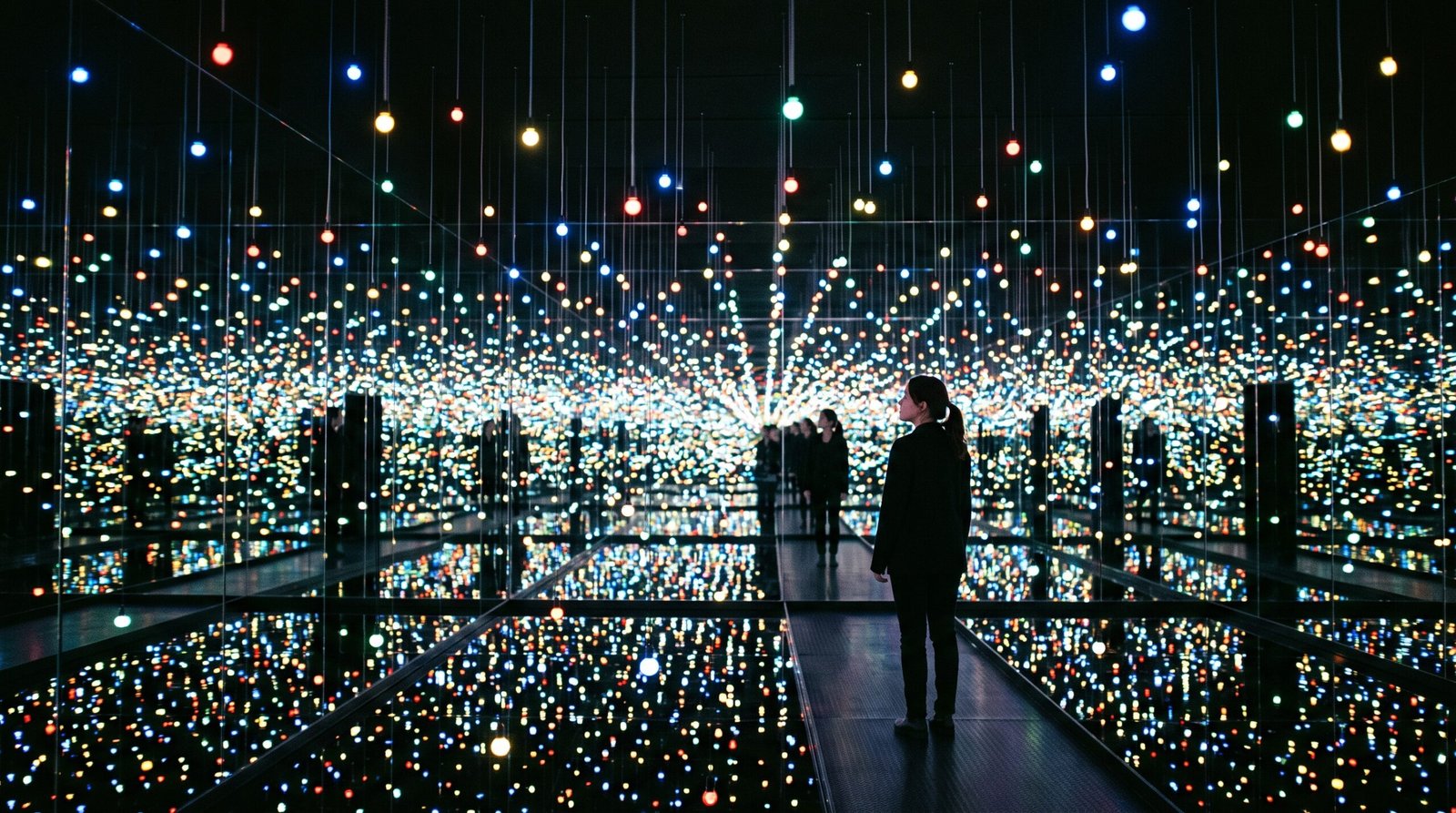
If any single body of work could be called Kusama’s masterpiece genre, it would be the Infinity Mirror Rooms — immersive, walk-in installations that multiplied light, color, and the viewer’s own reflection into what felt like an endless, living universe.
Her famous Infinity Mirror Rooms — large-scale installations that immersed audiences in endlessly repeating reflections of color and light — attracted millions of gallery visitors. Her Infinity Mirror Rooms came to draw hundreds of thousands to museums like Tate Modern in London, the Broad in Los Angeles, and the Hirshhorn Museum and Sculpture Garden in Washington, D.C.
These weren’t just art installations. They became cultural events, with visitors lining up for hours — sometimes days in advance — for just a 45-second peek inside infinity.
Polka Dot Paintings and Pumpkin Sculptures
Yayoi Kusama painted surreal worlds of swarming polka dots and turned them into soaring cultural and commercial success. Her distinctive pumpkin sculptures and polka-dot paintings generated millions of dollars in auction revenue. One painting, *Untitled (Nets)* (1959), sold for $10.5 million in 2022.
Her pumpkins — bulbous, polka-dotted, and placed in unexpected locations from museum gardens to seaside clifftops — became some of the most photographed sculptures in the world.
Fashion Collaborations
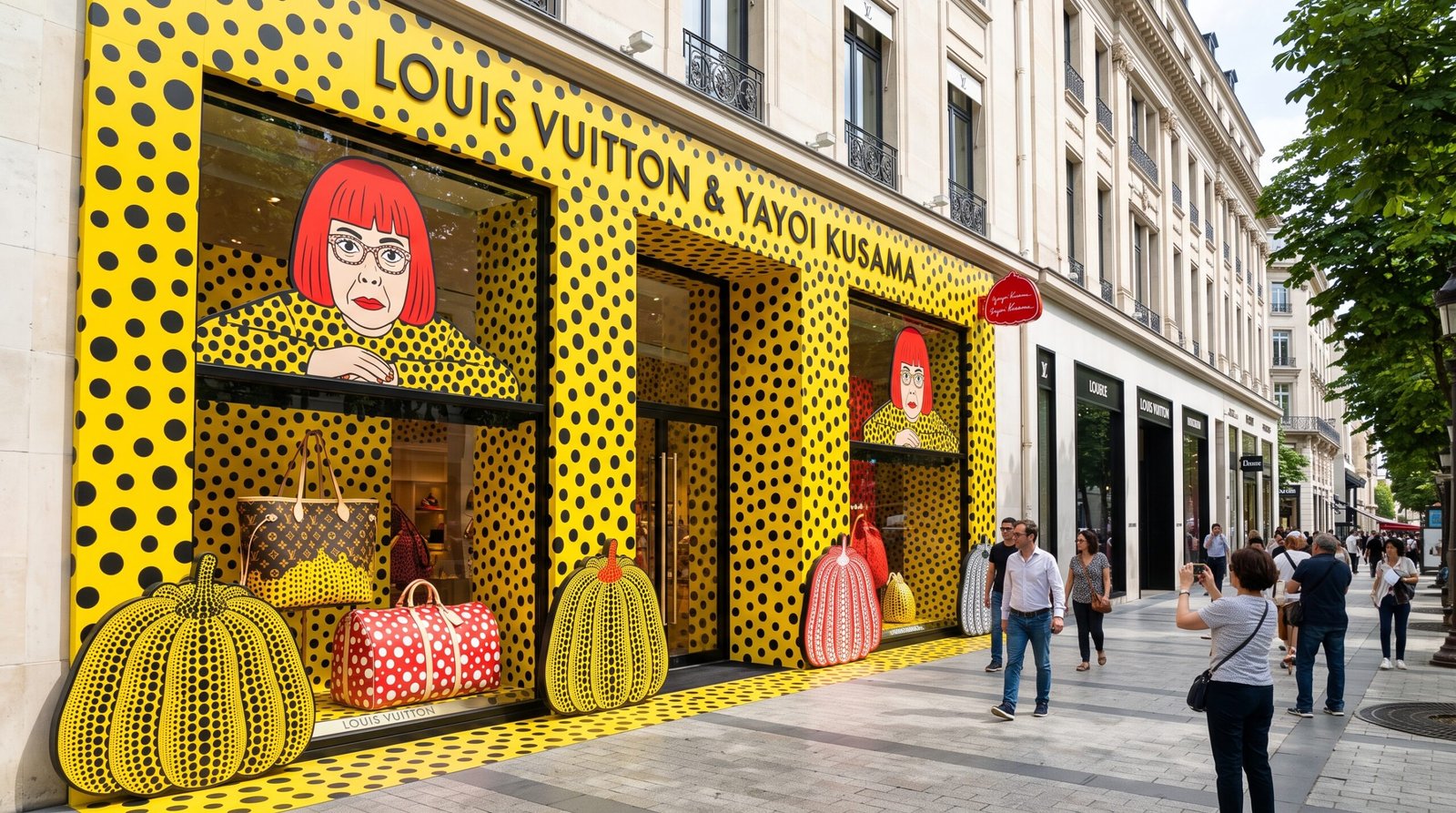
In her later years, Kusama partnered with fashion houses, including Louis Vuitton, and her illustrations and likeness appeared across a range of licensed products — teacups, T-shirts, keychains, and store-window displays. It was a cultural crossover that cemented her status not just as an artist, but as a global icon.
Kusama’s Journey — From Japan to New York and Beyond
Moving to New York in 1957
Family conflict and the desire to become an artist drove her to move in 1957 to the United States, where she settled in New York City.
This was a staggeringly bold move — a young Japanese woman arriving in 1950s New York, with little money and a vision nobody else could see yet.
She was in and out of psychiatric institutions for decades, although her illness did not hold her back. She was one of the first Japanese women to go to New York to pursue her art, in 1957.
Breaking Barriers in a White, Male-Dominated Art World
In New York, Kusama navigated a very white, very male art scene, fast gaining the respect of artists like Donald Judd, Joseph Cornell, and Eva Hesse with her experimental work, which was categorized under new labels like “soft sculpture” and “installation.” Still, she could barely make ends meet and struggled with suicidal ideation. Although Kusama’s work was full of joy and color, she was unafraid to address key battlegrounds of the day: gender equality, gay rights, and the anti-war movement. The art establishment often drew on, if not directly copied, Kusama’s work. But it never fully embraced her. Despite counting the likes of Andy Warhol and Donald Judd as friends, she remained an outsider.
She did not just break barriers. She painted over them — in polka dots.
Awards, Recognition & Commercial Success
During her lifetime, Kusama became a huge commercial success — a rarity for an artist, particularly a female one. Her international exhibitions attracted huge crowds and her works often sold for more than $1 million. Kusama won numerous awards, including the Order of Culture from Japan and the Ordre des Arts et des Lettres from France. She received the Order of Culture, Japan’s highest honor for artists, in 2016. She employed painting, sculpture, performance art, and installations in a variety of styles, including Pop art and Minimalism. Kusama was widely exhibited around the world, including the Museum of Modern Art and the Whitney Museum of American Art in New York, and the Museum Ludwig in Germany.
The World Reacts to Yayoi Kusama’s Death
The outpouring of grief from the global art community was immediate and immense.
David Zwirner, an art dealer who represented Kusama for 15 years, said she “was without a doubt the most famous living artist in the world” at the time of her passing. Kusama’s art influenced the histories of minimalism, pop art, and performance art,” he added. The news of her death was met with an outpouring of sadness from around the world, including museums that had exhibited her works. Fans and artists alike praised her courageous persistence in vowing to continue creating art that she said would be recognized thousands of years after her death.
Museums across the globe began paying tribute. Visitors flocked to her existing installations. Social media filled with dots. The art world paused — and then, appropriately, it kept creating. Just like she always said it should.
Yayoi Kusama’s Legacy and Influence on Modern Art
Kusama was, by the time of her death, one of contemporary art’s most popular and commercially successful figures. Throughout an extraordinary lifetime devoted entirely to artistic creation, Kusama pursued an internationally acclaimed career as a pioneering avant-garde artist whose creative practice encompassed visual art, performance, fiction, and poetry. Her hypnotic, unconventional works propelled her from near-obscurity to a place in the world’s most prominent museums.
She leaves behind a legacy that is, by design, impossible to contain. Her dots are on museum walls in Tokyo, New York, London, and São Paulo. They are on handbags and teacups and sticker sheets given to children. They are, in her own words, a way of “obliterating” the self — dissolving the individual into something infinite, something shared.
In her final years, Kusama was rarely seen in public, even as her works continued to grow in scale and spread across the globe.
She spent her last chapter the same way she spent her first: making art, every single day, despite everything.
That is her greatest work of all.
FAQ — Yayoi Kusama Death, Life & Legacy
Q1: When did Yayoi Kusama die?
Kusama died in a Tokyo hospital on August 14, 2026, according to a statement on her official website.
Q2: How old was Yayoi Kusama when she died?
Yayoi Kusama died at the age of 97.
Q3: What was Yayoi Kusama’s cause of death?
The cause of death was multiple organ failure, according to Kyodo News.
Q4: What is Yayoi Kusama most famous for?
Yayoi Kusama was known for her polka-dot paintings, pumpkin sculptures, and immersive Infinity Mirror Rooms.
Q5: Did Yayoi Kusama continue making art until the end?
According to a statement by the Yayoi Kusama Museum, she continued to paint until her very final days.
Q6: Where did Yayoi Kusama live in her later years?
After 1977, Kusama voluntarily lived in a Tokyo psychiatric hospital, where she continued to create art prolifically.
Q7: What awards did Yayoi Kusama receive?
Kusama won numerous awards, including the Order of Culture from Japan and the Ordre des Arts et des Lettres from France.
Q8: Who represented Yayoi Kusama as an art dealer?
David Zwirner, who represented Kusama for 15 years, called her “without a doubt the most famous living artist in the world” at the time of her passing.
Conclusion — A Dot That Will Never Fade
Yayoi Kusama spent her life turning her deepest fears — the hallucinations, the infinite patterns, the terror of existence — into some of the most joyful and awe-inspiring art the world has ever seen.
She didn’t just survive a difficult life. She painted it. Sculpted it. Mirrored it back to us in rooms so beautiful they made people weep.
She was 97 years old, and she never set down her brush.
The dots will go on. The rooms will remain. The infinity she spent a lifetime building cannot die with her — and that, perhaps, was always the point.
Rest in color, Yayoi Kusama. 1929–2026.